
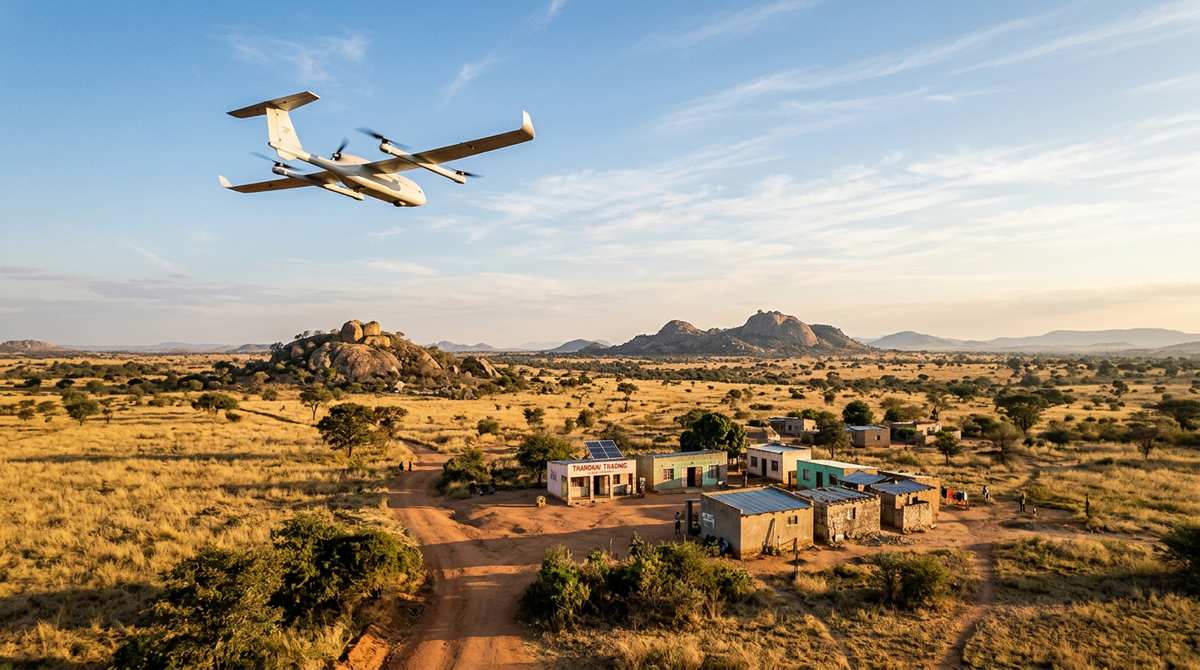
Zimpost flew its first official drone parcel on 10 October 2026, a short hop from Bambadzi Shopping Centre to Masendu Digital Centre in Bulilima District, Matabeleland South. The flight proves the aircraft works. It does not prove the service will last.
Across Africa, drone delivery has rarely failed on technology. It has stalled on contracts: who pays, how much, for which deliveries, and whether the deal survives a change of government. Rwanda answered those questions early and now has nationwide coverage. Ghana is renegotiating its deal in Parliament. Nigeria’s Kaduna State paused its service after an election. Zimpost now faces the same questions, and it has not yet answered any of them in public.
What happened in Bambadzi
Zimpost launched the service with its partner, Drone Solutions, at a ceremony attended by ICT Minister Tatenda Mavetera and her deputy, Dingumuzi Phuti, according to the Chronicle. Postmaster-General Maxwell Chitendeni framed the drones as a complement to existing postal routes, aimed at rural communities that are hard to reach by road. He also said Zimpost plans to use AI to plan delivery routes in cities.
The Minister set conditions rather than targets. She said aviation approvals, safety, reliability and cost must guide any expansion, and that health authorities must be involved in any medical deliveries. Her summary was blunt: “Every new technology must prove its value to the community.”
The regulatory groundwork was laid weeks earlier. In September 2026, the Civil Aviation Authority of Zimbabwe (CAAZ) approved Drone Solutions International to fly beyond visual line of sight (BVLOS) using the KITE aircraft built by Kite Aero, as DroneDJ reported. The company says the approval took six months of work with CAAZ and Air Traffic Services, and that its first planned use is moving pathology samples between regional health facilities and central laboratories. Unmanned Airspace reported that an earlier Zimpost test flight ran more than 100 km, from the Blue Ridge flight facility to Mrewa.
That approval marks a real shift. Under CAAZ’s 2016 drone rules, operators could not fly beyond line of sight or drop items from a drone at all.
Rwanda: ten years of state ownership
Rwanda is the benchmark because the government treated drones as public infrastructure from the start. It began working with the US company Zipline in 2016 to fly blood to hospitals. In 2023 alone, Zipline delivered 28,754 units of blood in Rwanda with an average delivery time of 25 minutes, according to The New Times. By 2025 the network served 27 of the country’s 30 districts and more than 900 health facilities.
The service then widened beyond emergencies. Zipline now carries about 400 essential medicines in Rwanda, plus animal vaccines and agricultural inputs, Le360 Afrique reported. One study of pig farming found artificial insemination success rose from 48.8% to 74.8% once semen arrived by drone. An earlier national agreement opened the network to other government bodies, including the agriculture ministry and the Rwanda Development Board, as Graphic Online reported.
In February 2026, Rwanda signed an expansion that makes it the first country with nationwide drone delivery coverage. The deal adds a third long-range hub in Karongi District, alongside Muhanga and Kayonza, and covers more than 11 million people, TechAfrica News reported. It also brings Zipline’s smaller urban drone to Kigali, where about 40% of national healthcare demand sits, and a Zipline AI and robotics testing centre, the company’s first R&D hub outside the US.
The health results are the strongest argument for the model. A February 2026 study reported a 46% drop in maternal deaths from postpartum haemorrhage at Rwandan hospitals served by the drones.
The lesson for Zimbabwe is structural. Rwanda’s service rests on a national contract, a government that commits to paying for operations, and the same political leadership across a decade.
Ghana: when the bill arrives
Ghana shows what happens when the contract pays for capacity rather than results. The Ministry of Health signed a service agreement with Zipline in 2018 for four distribution centres, later expanded to eight, the Ghana News Agency reported. The service launched in 2019.
In December 2025, Health Minister Kwabena Mintah Akandoh disclosed the terms. The contract is take-or-pay at $88,000 per centre per month, about $528,000 a month across six centres, Rainbow Radio reported. He cited an audit finding that only 12% of the areas served qualified as hard to reach and only 4% of deliveries counted as emergencies.
The arrears followed. By July 2026 the state owed Zipline about GH¢175 million, and the unpaid debt had already forced three distribution centres to close, according to the Minister’s answers in Parliament. Majority Leader Mahama Ayariga went further and called for the contract to be cancelled, arguing that the Ghana Health Service should buy and run its own drones. The current agreement expires in September 2027.
The drones in Ghana did fly, and the network did deliver. The dispute is over whether the state paid for flights it needed. A Zimpost contract that pays for idle capacity would carry the same risk.
Nigeria: Kaduna shows the political risk
Kaduna State invited Zipline in 2022 and opened a distribution centre at Pambegua. Between August 2022 and March 2023, the service delivered more than 225,000 vaccines, including 154,000 COVID-19 doses, plus blood products and emergency medicines, Nigeria Health Watch reported. Then a new state administration took office and put the operation on hold pending a review.
The programme worked, but it rested on a state-level arrangement that a new government could set aside. Nigeria Health Watch’s recommendation is the right one: write drone delivery into national vaccine and supply chain policy so it does not depend on one administration’s priorities. Zipline still runs centres in Bayelsa and Cross River states, TechCabal reported, and each centre can fly up to 300 missions a day.
Zimpost’s launch has a similar weakness. A ministerial ceremony is not a policy. Unless the service sits inside a budgeted national plan, its future depends on whoever holds the ICT portfolio next.
Côte d’Ivoire and Malawi: disclosure and local capacity
The money behind Africa’s newest drone contracts now comes partly from Washington. On 25 November 2025, the US State Department awarded Zipline up to $150 million to expand in Rwanda, Ghana, Nigeria, Kenya and Côte d’Ivoire, DroneXL reported. Funds are released only when a government signs a national contract and commits to paying operating costs, which could total about $400 million across the five countries.
Côte d’Ivoire signed an eight-year public-private partnership in December 2025 to grow from one hub in Daloa to ten. Since 2023 the Daloa hub has delivered more than 3.55 million medical products to over 220 health facilities, The Condia reported. Officials and Zipline put the state’s return at about 300%. DroneXL points out that nobody can check that figure, because the government has not disclosed what it pays.
Malawi took a different route: test first, buy later. After a 2016 pilot that flew dried blood samples for infant HIV testing, the government and UNICEF opened Africa’s first humanitarian drone testing corridor at Kasungu Aerodrome in June 2017, CNN reported. Universities and companies could test there. Malawian students built a drone called EcoSoar for about $350 and flew it 19 km autonomously from a health clinic, UNICEF reported.
Zimbabwe sits between these models. Its operator is local, with a CAAZ-approved flight school in Harare, and its aircraft are imported from Kite Aero. That gives Zimbabwe a chance to keep pilot training, maintenance and flight operations in local hands, if the contracts are written to protect them.
What Zimpost has not told us yet
The launch coverage named partners and possibilities. It did not publish a single commercial term. Zimpost, Drone Solutions and the Ministry of ICT, Postal and Courier Services need to answer six questions:
- Who pays, and on what basis? Ghana’s take-or-pay model charged for capacity whether or not drones flew. Will Zimpost pay per delivery, per hub, or not at all during the trial?
- What does a delivery cost? McKinsey estimated the direct operating cost of a single drone parcel at about $13.50, TechCabal reported. What will a Bulilima customer pay, and who covers the gap?
- Where does it fly next? Bambadzi to Masendu is a demonstration route. Which districts are in the rollout plan, and on what timeline?
- Who owns the health use case? The Minister said health authorities must be involved in medical deliveries. Has the Ministry of Health and Child Care signed on, and on whose budget?
- Is it in national policy? Kaduna’s pause shows what happens to programmes that live outside budgets and plans. Will drone delivery be written into the postal sector or health supply chain strategy?
- What happens to the data? AI route planning and delivery tracking generate data on customers and patients. Where is it stored, and who can access it?
Zimbabwe has the regulatory approval, a local operator and a willing postal service. Rwanda shows what that can become. Ghana shows what it costs when the contract is wrong.