
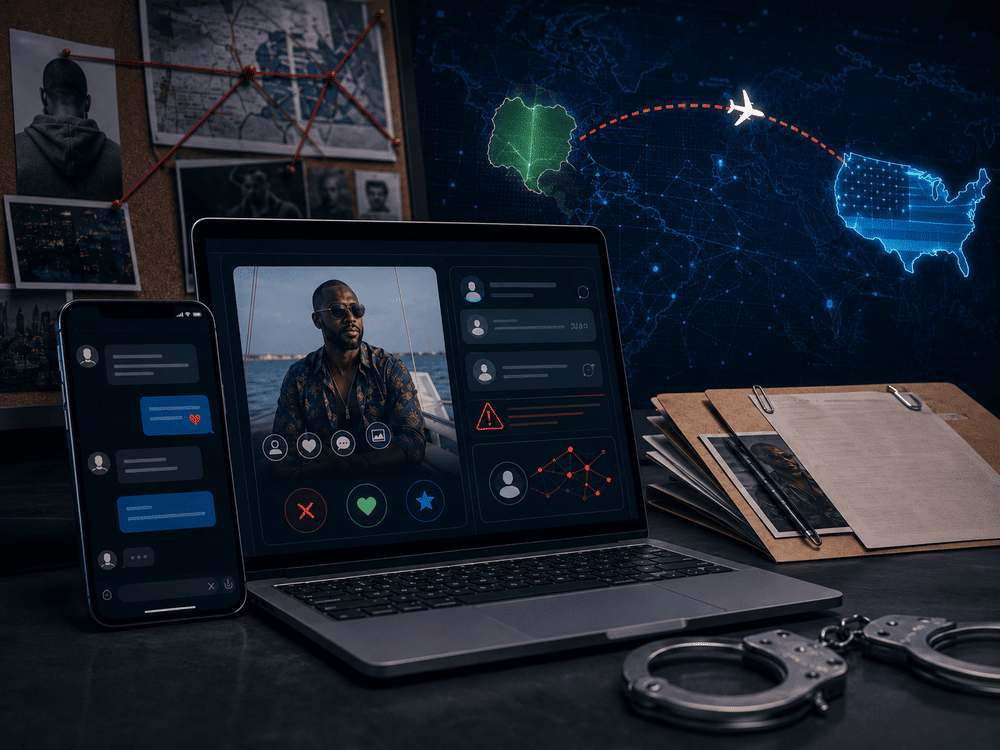
Nigeria has extradited suspected cyber fraud operator Samuel Ugberease, also known as Putsammy, Putput and Sammy, to the United States to face charges linked to online romance scams, wire fraud and related financial crimes.
According to reports by Premium Times Nigeria, TheCable and Punch Nigeria, the extradition was carried out through the INTERPOL National Central Bureau in Abuja after coordination between Nigerian and American law enforcement authorities.
Ugberease, who was reportedly based in South Africa before his arrest, was extradited in May 2026 to face prosecution in the United States. Nigerian police say the suspect and his alleged accomplices operated a romance scam syndicate between 2014 and 2018, targeting women in the United States, particularly within the Eastern District of North Carolina.
The allegation is that the syndicate created fake online identities and dating profiles, built emotional relationships with victims, then manipulated them into sending money under false pretences. In one reported case, a victim allegedly lost more than US$1.5 million.
This case matters because romance scams are no longer just isolated inbox tricks. They are now part of a wider cybercrime economy built on identity fraud, social engineering, cross border money movement and weak digital trust.
The old image of a lone scammer sending badly written emails is outdated. Modern romance scams can run for months. Victims are profiled, groomed and emotionally pressured. The fraud often starts on social media, dating apps or messaging platforms, then slowly moves into fake emergencies, fake investment schemes, fake shipping fees, medical claims or supposed business problems.
The technology has also improved. Scammers can now use stolen photos, AI generated profile images, translation tools, voice cloning and scripted emotional conversations to appear more believable. That makes the scam harder to detect, especially for victims who are lonely, grieving, financially vulnerable or simply trusting.
The scale of the problem is not small. The US Federal Trade Commission says people reported losing US$2.1 billion to social media scams in 2025, about eight times the figure reported in 2020. The FTC also says nearly 60 percent of people who reported losing money to a romance scam in 2025 said it started on a social media platform.
For African countries, the bigger issue is reputation and enforcement.
Nigeria has long carried the burden of global association with online fraud, sometimes unfairly and sometimes because real criminal networks have exploited its digital talent pool, banking gaps and weak enforcement history. But this extradition sends a different signal. It shows that cybercrime suspects can be tracked, arrested, processed through court and handed over where international law allows.
That matters for Africa’s digital economy. The continent cannot build credible fintech, ecommerce, digital identity, remittance and AI services while fraud networks are allowed to exploit the same digital infrastructure. Once trust collapses, everyone pays the price: platforms, banks, startups, diaspora users and ordinary consumers.
This is where legal frameworks also matter. In Zimbabwe, for example, the Cyber and Data Protection Act created a legal foundation for issues such as data protection, cybercrime investigation and the admissibility of electronic evidence. The challenge across many African markets is not simply having laws on paper. It is whether enforcement teams have the skills, tools and cross border partnerships to act quickly when fraud moves across platforms, banks and jurisdictions.
But enforcement alone will not solve the problem.
Dating platforms need stronger identity checks without turning their apps into surveillance machines. Banks and mobile money operators need better transaction monitoring for suspicious money flows. Telecoms companies need to do more on SIM fraud and number abuse. Social media companies need faster takedown systems for impersonation accounts. Governments need cybercrime units that understand both the technology and the psychology of these scams.
The public also needs better digital literacy. The uncomfortable truth is that many victims do not lose money because they are foolish. They lose money because scammers understand emotion better than most security campaigns do.
A warning poster that says “do not send money to strangers online” is not enough when someone has spent three months building daily emotional dependence with a victim.
The extradition of Ugberease is therefore not just a Nigerian police story. It is a reminder that cybercrime has become transnational, patient and deeply human in its methods.
Africa’s response must be just as serious. Not panic. Not slogans. Not occasional arrests for public relations. Serious investigation. Better platform accountability. Stronger cross border cooperation. Faster victim reporting channels. And a public that understands that online affection can also be a weapon.