
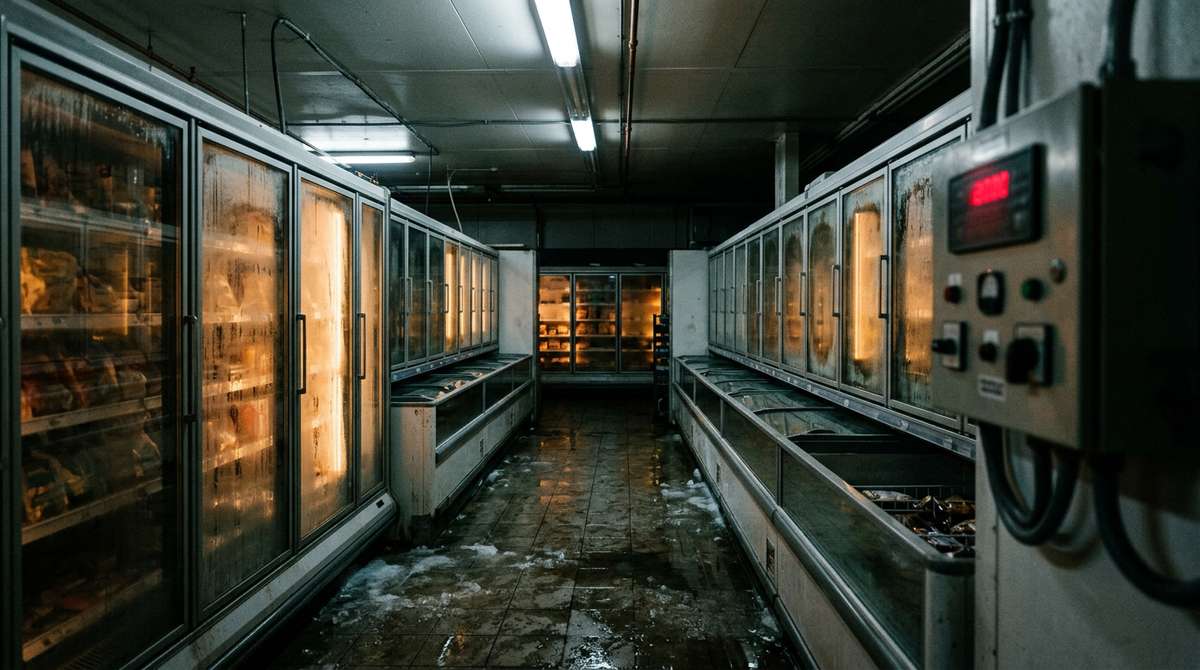
Overnight on 11 October 2026, attackers took remote control of refrigeration systems in hundreds of French supermarkets and set fridges and freezers to 50°C. By morning, stores had binned their frozen and fresh food, several had fires, and France’s cybersecurity agency was investigating what one retail chief called an unprecedented attack on the country’s food supply.
Nothing so far suggests the attackers needed advanced tools. Reports indicate they reached control panels exposed to the internet, and the manufacturer says the affected units ran outdated firmware. That is the lesson for the rest of the world, Zimbabwe included: the weak points were already there, and AI is making them cheaper to find and faster to exploit.
What happened
The attack ran through the night of Sunday 11 October into Monday 12 October. Les Mousquetaires, which owns Intermarché, said fridges at about 150 of its stores were held at 50°C for six hours, ABC News reported. Carrefour told Le Parisien that 80 of its 6,000 stores were affected, The Stack reported. Coopérative U and E.Leclerc also confirmed they were hit, and Monoprix was among the chains reported affected.
The damage went beyond spoiled stock. Overheating equipment started fires in several stores, and sprinkler systems flooded others, ITPro reported. Les Mousquetaires told TIME its losses could reach several million euros. Coopérative U chief executive Dominique Schelcher called the targeting of equipment essential to France’s food supply extremely grave.
The Paris prosecutor’s office opened an investigation into what it called a large-scale attack, and Prime Minister Sébastien Lecornu ordered the national cybersecurity agency, ANSSI, to investigate. Dutch grocery group Ahold Delhaize separately said it was dealing with a security issue on its network, CBS News reported. The incident also resembles disruptions at about a dozen US military commissaries in late August, where fridge failures caused food losses.
As of 13 October, investigators had not publicly named the attackers or confirmed how they got in.
How it happened
A supermarket’s cold aisles usually run from one control panel that manages every fridge and freezer in the store. Many of those panels are reachable over the internet so maintenance contractors can adjust them remotely. That convenience is the attack surface.
An ANSSI alert named two Danfoss product lines, the AK-SC and AK-SM refrigeration managers, TIME reported. Danfoss, the Danish group, said it knew of incidents affecting a limited number of systems, that the affected units ran outdated firmware, and that it had long advised customers to update supported systems and replace legacy ones. Attackers appear to have pushed the controllers into a continuous defrost cycle with a target temperature of 50°C.
The weakness was not secret. On 9 August 2026, Claroty’s Team82 published research on the Danfoss AK-SM 800A system manager. It found three flaws, including a hidden “code of the day” login that could bypass authentication and a command injection bug allowing remote code execution, and counted 2,765 of these management interfaces exposed online, SecurityWeek reported. Danfoss fixed the flaws in firmware R4.3.1. France held nearly 60% of the exposed Danfoss controllers found in internet scans, according to TIME.
Two questions remain open. Investigators have not confirmed whether the attackers used the flaws Claroty disclosed or older weaknesses in end-of-life models. And no one has publicly explained why so many controllers that run a country’s food stocks were reachable from the open internet.
Our view: what AI changes
There is no evidence that AI played any part in the French attack. That is exactly why it matters. If old firmware and exposed control panels can empty the freezers of a G7 country’s supermarkets, consider what happens when finding and exploiting those weaknesses gets cheaper. Four shifts are already under way.
The gap between disclosure and attack is closing. Claroty’s research sat in public for two months before this attack. That window is shrinking because AI models can now turn a published flaw into working attack code. On 29 September, Anthropic‘s Frontier Red Team reported that GLM-5.3, an open-weight model from Chinese developer Z.ai, built working exploits in 50 of 410 attempts on a benchmark of known browser flaws, close to the 56 managed by Anthropic’s restricted Claude Mythos Preview, The Next Web reported. The US standards body NIST separately called GLM-5.3 the most cyber-capable open-weight model released to date. Anyone can download it, and Anthropic found its built-in refusals could be stripped with simple techniques.
Scale stops being a constraint. Hitting hundreds of stores across several chains in one night takes reconnaissance: finding exposed devices, identifying firmware versions, and running the same change everywhere. AI agents do that kind of repetitive technical work tirelessly. Expect more attacks that hit many sites at once rather than one victim at a time.
Attacks are moving from data to physical damage. Most cyber incidents still steal or encrypt data. This one destroyed food and started fires. The same class of controllers runs cold rooms, water pumps, building systems and factory lines. On the day the attack came to light, Anthropic published research showing small AI models may soon be able to copy themselves across poorly secured connected devices on their own. Cheap, unpatched equipment is becoming both a target and a home for malicious software.
Defenders get the same tools, but only if they use them. Anthropic says vetted defenders using Claude Mythos Preview through its Project Glasswing programme have found more than 10,000 vulnerabilities in critical software. AI can audit firmware, map an organisation’s exposed devices and write patches. The French controllers needed no new technology to protect them: firmware updates for current models, and replacement for legacy units the vendor no longer supports.
A note of caution on the sources. Much of the public evidence on AI-enabled attacks comes from AI labs, and Anthropic sells closed models that compete with the open-weight models it warns about. Critics, including Lawfare writer Tom Uren, argue open-weight models are valuable to defenders precisely because they are cheap and run locally, Trending Topics reported. Both things can be true: the capability is real, and so is the commercial interest in how it is framed.
What it means for Africa
This is not only a European problem. Internet scans found the same Danfoss refrigeration controllers exposed in South Africa, the US and the UK, according to TIME. Southern African retailers, cold-storage operators, horticulture exporters, pharmacies and hospitals all depend on refrigeration systems that contractors manage remotely.
The practical steps are not new, and none require AI:
- Find what is exposed. List every controller, panel and building system that can be reached from the internet, including those your maintenance contractor set up.
- Take it off the open internet. Put remote access behind a VPN or a secured gateway with unique passwords and multi-factor login.
- Patch or replace. Update firmware on supported equipment and plan to replace units the vendor no longer supports.
- Check your contractors. Ask who can log in remotely, from where, and how that access is logged. Write the answers into the maintenance contract.
- Monitor independently. Fit separate temperature alarms that alert a person by SMS, so a compromised controller cannot hide a failure.
The French attack took six hours to discover because staff found out when they opened the freezers in the morning. The next attack will be faster to launch. The question for every business is how fast it can notice.