
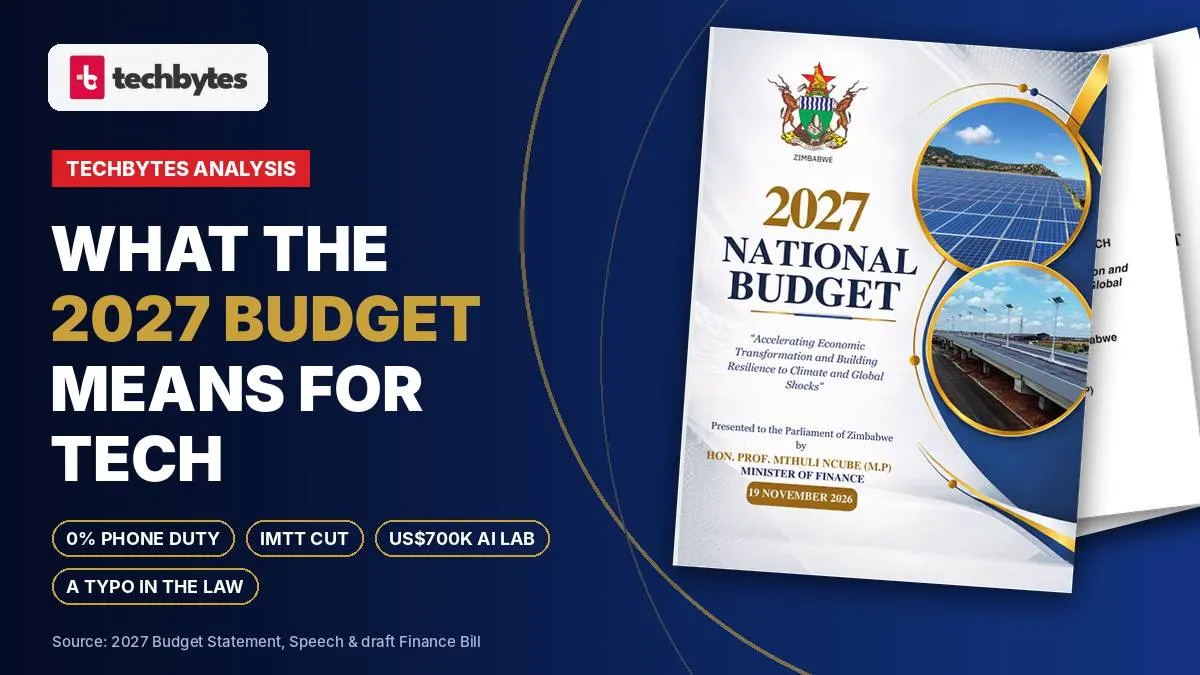
Zimbabwe‘s Finance Minister Mthuli Ncube’s 2027 budget gives tech its most popular headline in years: customs duty on cellular phones falls from 25% to 0%. But if you read past the speech and into the full 284-page Budget Statement and the draft Finance Bill, a different picture emerges. The phone cut is about catching smugglers, not about cheaper phones. Tech’s share of the budget is tiny. And the draft law that cuts the money transfer tax contains a drafting error.
TechBytes Africa read all three documents. You can read them too: they’re attached at the end of this article.
The phone duty cut is a tax play, not a gift
The Budget Statement explains the reason in plain terms (paragraphs 628 to 630). The 25% duty created a price gap between phones imported formally and phones that come in “through informal channels, including undeclared imports.” That gap hurt compliant retailers and pushed buyers to the informal market.
Removing the duty is meant to make formal shops competitive again. Treasury then expects to recover the lost duty through VAT, as more phones are sold through registered shops. In Treasury’s words, the cut should be “compensated, in part through improved compliance and broader consumption tax collection.”
That matters for buyers. VAT still applies at the till, and retailers set the final price. A phone won’t automatically be 25% cheaper.
Two more details matter:
- No start date. Customs duty on automated teller machines (ATMs) is removed “with effect from 1 January 2027.” The phone measure has no date at all.
- It’s not in the Finance Bill. The draft Finance Bill doesn’t mention phones. Customs duty rates are changed through the customs tariff, usually by statutory instrument. Until that instrument is gazetted, 0% is still a proposal.
Tech gets 0.29% of the budget
The ICT Ministry receives ZiG1.03 billion. The total budget is ZiG358.3 billion, so tech gets about 0.29%. Using Treasury’s own conversion of ZiG358.3 billion to US$12.8 billion, that’s roughly US$37 million for the whole ministry. Home Affairs gets ZiG21.8 billion, more than 20 times as much.
The Budget Statement’s Table 34 lists where ZiG305 million of the ICT money goes. A selection:
| Project | Allocation | About (US$) |
|---|---|---|
| ICT Lab per School | ZiG50 million | 1.8 million |
| ICT Government Fusion Centre | ZiG40 million | 1.4 million |
| Disaster Recovery Plan upgrade | ZiG35 million | 1.25 million |
| National Data Centre / AI-Compatible Data Centre | ZiG30.8 million | 1.1 million |
| AI Laboratory (AI Directorate) | ZiG20 million | 0.71 million |
| Last Mile Connectivity | ZiG20 million | 0.71 million |
| Presidential Internet Scheme | ZiG20 million | 0.71 million |
| Public Key Infrastructure | ZiG10 million | 0.36 million |
The speech promises to “embed technology, AI and innovation in all sectors of the economy.” The national AI Laboratory gets about US$700,000. Last-mile connectivity, the part that actually brings rural people online, gets the same. For comparison, the Ministry of Information gets ZiG580.6 million to finish the switch to digital broadcasting, more than half the size of the entire ICT Ministry budget.
Treasury also says internet penetration is now 87.3% and mobile penetration 108.5%. Those are Treasury’s figures, and the Statement doesn’t say how they’re measured. A mobile penetration above 100% usually reflects people with more than one SIM card, not universal access.
Netflix, Meta and Spotify: the tax net is tightening, slowly
Zimbabwe already charges a Digital Services Withholding Tax (DSWT) on payments to offshore platforms such as streaming, social media, cloud computing, e-hailing and online gambling. The 2027 budget changes how it works (Statement, paragraphs 687 to 695):
- No more double tax. Imported digital services will be exempt from VAT where DSWT has already been withheld by a bank.
- A new tracking system. ZIMRA will buy a system called e-TRACE, through a public tender, to monitor transactions by digital service providers.
- Taxing where the users are. Government plans to attribute revenue to Zimbabwe “based on user location” and review registration thresholds, so large foreign platforms fall inside the tax net.
- Goods are excluded. DSWT won’t apply to goods bought on online platforms. Those still face customs duty at the border.
Most of this is intention, not law. The user-location rules aren’t in the draft Finance Bill. Separately, e-commerce operators will be required to file tax returns.
IMTT falls, and the draft law gets the number wrong
The Intermediated Money Transfer Tax drops from 1.5% to 1.25% on ZiG transactions and from 2% to 1.75% on US dollar transactions, from 1 January 2027. Transactions worth US$500,000 or more pay a flat US$10,150.
Industry wanted the tax scrapped entirely. Treasury cut it by a quarter of a percentage point.
There’s also a problem in the draft Finance Bill. Clause 5(b), which sets the new US dollar rate, reads: “one comma zero seven five per centum (1,75%)”. In words, that’s 1.075%. In figures, it’s 1.75%. Tax law is enforced on its exact wording, so Parliament needs to fix this before the Bill passes.
It isn’t the only slip. Clause 4’s new income tax table has the fourth band ending at US$14,200 and the fifth band starting at US$14,001, so the two bands overlap by US$199. The Bill is marked “Departmental Draft,” which is the right time to catch errors like these.
Crypto: in the tax system, but not yet taxed
The draft Finance Bill adds virtual asset service providers registered under the Securities and Exchange Act to the definition of “financial services” for VAT. That gives registered crypto platforms the same VAT treatment as other financial services.
The Statement also proposes Capital Gains Tax on the disposal of virtual assets, but it doesn’t set a rate, and that measure isn’t in the draft Bill. For now, Zimbabwe is signalling that crypto profits will be taxed without saying how much or when.
Network operators get cash-flow relief
Mobile networks and internet providers get two measures. VAT on imported telecommunications equipment can be deferred, and the change is already in the draft Bill (clause 9). And customs duty on capital equipment that is still liable to duty will be removed. That eases the cost of rolling out networks.
The budget says it aims to “reduce the cost of ICT services to broaden access.” But it contains no measure that lowers data prices directly. Operators pay less up front, and nothing in the documents requires them to pass that saving on to customers.
What’s missing
- Laptops and tablets. The duty cut covers cellular phones only. Students and remote workers who need a computer get nothing.
- Startups. There’s no tax incentive aimed at tech startups or digital exporters, despite the speech’s focus on “new technology-based frontiers of business.”
- A data price plan. Lower data prices are a stated goal, but there’s no mechanism to achieve them.
The verdict
The 2027 budget treats tech mainly as a tax base, not a growth sector. The headline measures (cheaper phones, digital services tax, e-commerce returns, crypto rules) are mostly about bringing activity into the formal system and taxing it. That isn’t necessarily wrong, but it’s not the same as investing in the sector. With 0.29% of the budget and a US$700,000 AI lab, Zimbabwe’s tech ambitions are still mostly words.
What to watch
- The statutory instrument setting the 0% phone duty, and its start date.
- The fix to clause 5(b) of the Finance Bill before Parliament passes it.
- The e-TRACE tender from ZIMRA.
- The rate for Capital Gains Tax on crypto, when it’s announced.
- Whether phone prices actually fall in formal shops in early 2027. TechBytes will check.