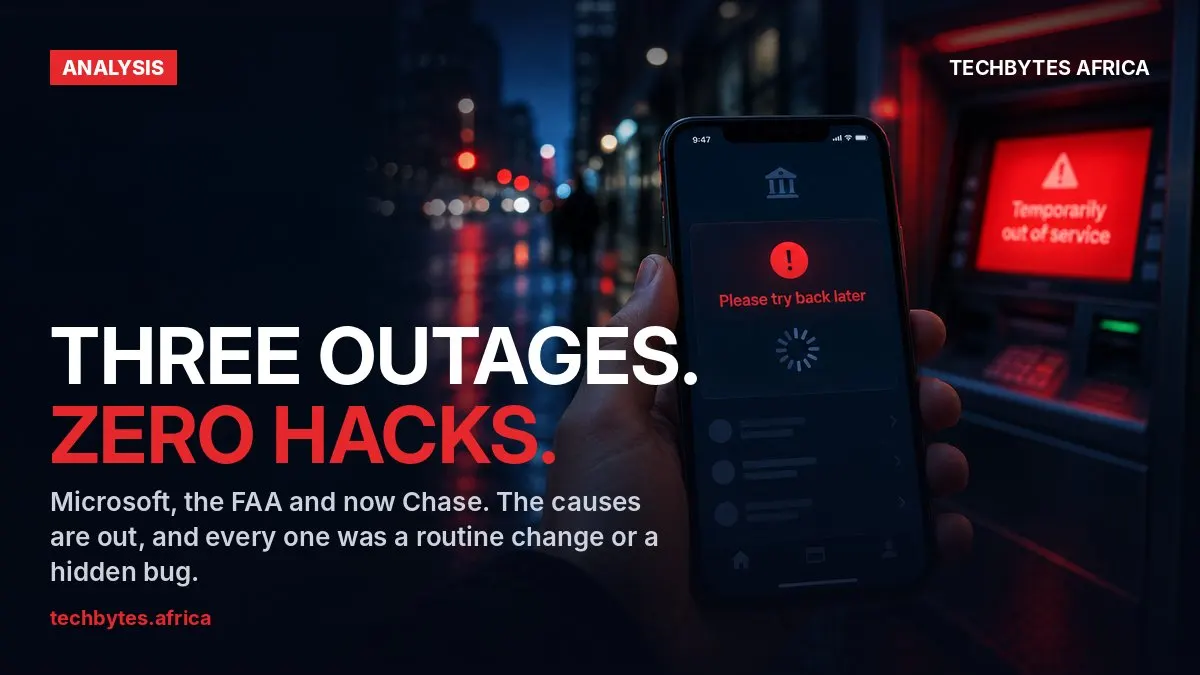
Microsoft, the FAA and now America’s biggest bank have all named their causes. Not one was an attacker. And in Paraguay, millions learned what happens when a bank’s app goes dark for good.
Last week we asked whether the back-to-back failures at Microsoft and the FAA were really what officials said they were. In the days since, both organisations have named their causes. And on Monday, a third giant went down.
Chase: a bug that spread to other banks
On Monday, 16 November, JPMorgan Chase customers started seeing errors at about 11:30am US Eastern time (18:30 in Harare). By the afternoon, people couldn’t see their balances or make transfers, and some got a “Please try back later” message. Transactions only returned to normal at about 6:30pm Eastern, seven hours later.
Chase blamed “a software bug in an on-premise hardware system” and said the problem was not cyber-related. It also said the problem was “not systemic.”
Customers at other banks saw it differently. People at Bank of America, Wells Fargo, US Bank, Capital One and Truist all reported trouble, because any payment involving Chase got stuck. Zelle, the payment network many of those banks own together, said its own systems were fine but that delays could come from member banks. US Bank warned that Zelle payments with other banks could be delayed.
One detail stands out. In a statement to CBS News, US Bank called the incident a “cyber outage.” Chase says it wasn’t cyber-related. Neither bank has explained the difference in wording.
Microsoft: a bug that sat unnoticed since July
Microsoft has now published a preliminary post incident review, and it’s more revealing than the first-day statements.
The trigger was a software bug in an update to Microsoft 365’s gateway servers, installed in July. It ran for more than three months without causing trouble. Then three things lined up. About 15 hours before the outage, Teams moved its traffic onto the same infrastructure Exchange Online uses. Roughly 14% of gateway capacity was already offline for an unrelated reason. And the bug overloaded servers under exactly those conditions.
Within two hours, more than 80% of the servers had stopped responding. Microsoft’s regional safeguards didn’t hold, and the failure spread worldwide. Teams, OneDrive and SharePoint could move to backup infrastructure. Exchange Online couldn’t, so mailboxes stayed down for almost exactly 24 hours, from 11:20am Eastern on Thursday to 11:10am on Friday.
Why did testing miss it? Microsoft’s load tests ran on older hardware with fewer processor cores than the real servers. In Microsoft’s words, the problem “is worsened on machines with more cores and newer hardware.” Its tests were built to pass on hardware that doesn’t match what customers actually run on.
Microsoft has apologised and says it will add capacity, improve monitoring, and add safeguards so that rerouted traffic can’t set off another chain of failures.
The FAA: a cable upgrade on a Friday afternoon
The FAA’s explanation is just as ordinary. According to Transportation Secretary Sean Duffy, contractor L3Harris was replacing copper wiring with fibre-optic cable at a remote site. Afterwards, a router overloaded a critical communication system. The FAA says two sources were hitting the network with about a thousand connections every four to five seconds.
The work was done at 3pm on a Friday, at one of the busiest times of the week. Duffy says the FAA will rethink when it schedules this kind of work. Officials are still deciding whether the fault was user error, installer error or a faulty router. FAA Administrator Bryan Bedford said there was “zero evidence of anything AI-related.”
Paraguay: when the app goes dark and doesn’t come back
Chase customers waited seven hours. In Paraguay, customers of Ueno Bank woke up on 3 November to find the app dead, their cards declined and payments stopped. This time no fix was coming.
Ueno was the country’s largest digital lender, with about 3 million customers, roughly 60% of Paraguay’s adults. The Central Bank of Paraguay seized it after finding its solvency ratio had fallen below half the legal minimum. Regulators also found about $146 million lent to companies linked to its controlling shareholder, some of it beyond legal limits.
This was not a cyberattack or a technical failure. But for customers it felt the same, only worse. The bank held about $850 million in public money, including about $380 million from the state pension and health fund. Deposits are guaranteed only up to about $38,000 per customer.
The fallout went all the way to the top. President Santiago Peña had appointed Ueno’s former chief as central bank governor, and he had been a business partner of the group that owns the bank until 2025. Within days, Congress impeached him, the Senate removed him, and he was placed under house arrest. Peña denies wrongdoing, and Ueno says he was never a shareholder.
Paraguay shows the risk under all the technical outages: when most of a country’s money runs through a single app, that app becomes a single point of failure. A bug can take it down for hours. Bad governance can take it down for good.
What the four have in common
None of these was a cyberattack. That’s the reassuring part. The less reassuring part is that each one came from inside:
- Microsoft: a bug it shipped itself, missed by tests that didn’t match its real hardware.
- The FAA: routine upgrade work by its own contractor, scheduled at peak time.
- Chase: a software bug in its own on-premise hardware.
- Ueno: lending to related companies that regulators say broke the rules.
And in each case, the damage spread further than it should have. Microsoft’s failure spread from server to server across the world. The FAA’s spread from one site to the whole country. Chase’s spread from one bank to the rest of the US payment system. Ueno’s spread from one bank into a nation’s pension fund and its presidency.
This is what concentration looks like. Every link between systems makes things faster and cheaper on a normal day, and lets one failure spread on a bad one. The safeguards meant to contain those failures — staged rollouts, regional isolation, sensible scheduling, independent regulators — didn’t work in any of the four cases.
What to do when your bank goes down
Outages like these are also when scammers move in. If your banking app fails:
- Use official channels only. Check your bank’s verified social media accounts or website for updates. Ignore texts or calls offering to “fix” your account.
- Keep another way to pay. A card from a second bank, some cash or a mobile wallet can get you through a day.
- Don’t keep everything in one place. Ueno’s customers learned the hard way what happens when all your money sits in one app.
- Screenshot everything. Record failed or duplicated transactions so you can claim back fees or charges later.
- Don’t keep retrying the same payment. Repeated attempts can go through twice once the system recovers.
What to watch
- Microsoft’s final post incident report, due this week. Look for whether it explains why its tests used weaker hardware than production.
- The FAA’s root-cause finding on the L3Harris work, and whether anyone is held accountable.
- Whether Chase or US bank regulators publish anything more than a single-sentence explanation, and whether US Bank explains its “cyber outage” wording.
- How quickly Paraguay pays out Ueno depositors, and what happens to balances above the guarantee.
TechBytes will keep reading the reports as they come out. Last week’s questions now have partial answers. The bigger one is still open: who is responsible for making sure one mistake can’t take down a whole system?
Related: Microsoft 365 Goes Dark: Fixes Keep Failing in Global Outlook and Teams Outage | Two Days, Two Meltdowns: What Microsoft and the FAA Still Aren’t Telling Us