Safaricom’s latest M-Pesa numbers tell a bigger story than just growth. They show that the future of African fintech may be built on something very simple: making small everyday payments cheap enough that people stop thinking twice before using them.
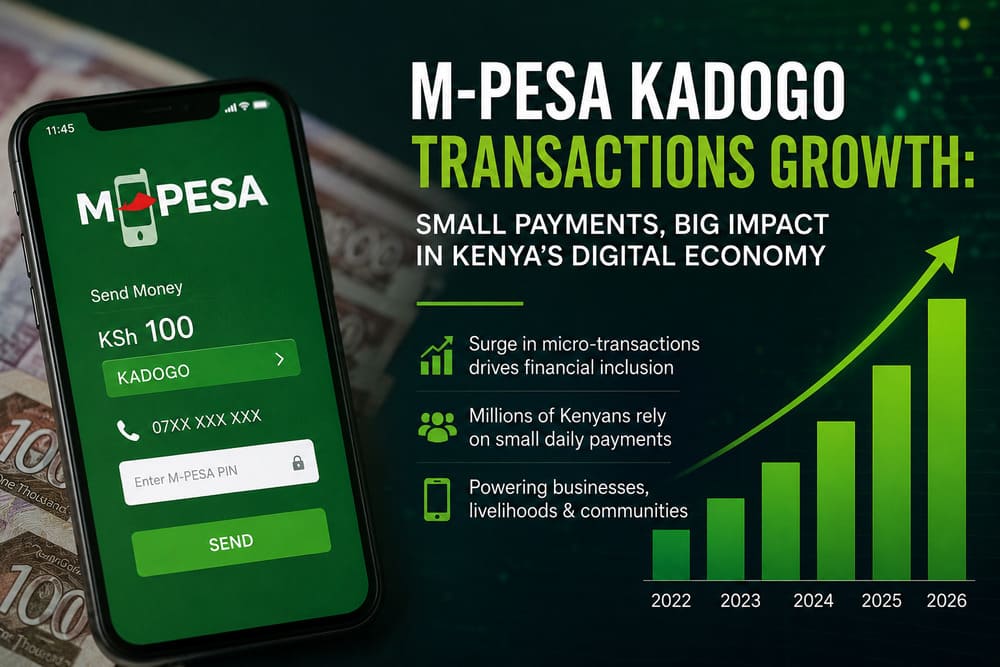
M-Pesa processed 46.4 billion transactions worth KES 41.7 trillion in the 2025 and 2026 financial year. Within that activity, M-Pesa Kadogo accounted for 17.1 billion free transactions.
Kadogo, which means small in Swahili, is Safaricom’s zero rated small transaction structure. It covers person to person transfers of KES 100 and below, merchant payments below KES 200, cash deposits at agents and airtime purchases made through M-Pesa.
On paper, this sounds like Safaricom is giving away a large part of its transaction business for free. In reality, it may be one of the smartest moves in African mobile money.
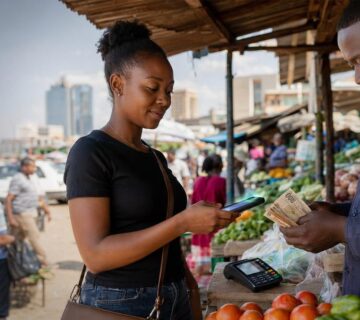
The logic is not complicated. A fee that looks small to a bank or telecom operator can be a deal breaker for a low income user. If someone is sending KES 50, buying vegetables, paying a boda boda rider, topping up airtime or paying a small trader, even a minor charge can make the transaction feel irrational.
Remove that charge and behaviour changes.
People transact more often. Merchants accept more digital payments. Small traders stop treating mobile money as something for larger transactions only. Customers keep money inside the wallet instead of withdrawing it too quickly. The platform becomes part of daily life, not just a tool for emergencies.
That is the real lesson from M-Pesa Kadogo.
Safaricom still grew M-Pesa revenue by 13.4 percent to KES 182.7 billion, even as billions of small transactions carried no direct fee. M-Pesa now contributes about of Safaricom Kenya’s service revenue, showing how deeply mobile money has moved into the centre of the business.
There is one important point that needs care. Some reports describe the 17.1 billion Kadogo transactions as 58 percent of M-Pesa activity. But simple arithmetic shows that 17.1 billion out of 46.4 billion is about 36.8 percent of total M-Pesa transactions. The wider point still stands: free and low value transactions are no longer a side story. They are now a major driver of usage.
This matters beyond Kenya.
Across Africa, mobile money operators, banks and fintech startups keep talking about financial inclusion. But many still charge in ways that punish small users. That is the blind spot. You cannot claim to serve the mass market while making small digital payments feel expensive.
The user at the bottom of the income ladder is not asking for a pitch deck about inclusion. They are asking whether it makes sense to send, receive, save or pay digitally without losing money in fees. If the answer is no, they will go back to cash.
This is where Kadogo becomes a serious case study.
It shows that free transactions do not always mean lost money. They can increase platform habit, merchant adoption and wallet activity. The operator may earn less on the individual transaction, but more from the wider payment system around it. Business payments, merchant services, lending, savings, overdrafts, merchant tools and investment products can all sit on top of that daily usage.
That is already visible in the broader M-Pesa business. Products such as Pochi la Biashara, which helps small business owners separate business money from personal funds, have grown quickly. Reporting by Techweez says Pochi la Biashara users grew from 600,000 in the 2024 financial year to 2.2 million in the most recent year, with revenue rising to KES 4 billion.
Safaricom is also pushing M-Pesa beyond basic transfers. Earlier this year, Reuters reported that Safaricom had launched Ziidi Trader, allowing M-Pesa users to buy shares on the Nairobi Securities Exchange directly from their phones.
That direction is important. M-Pesa is no longer just a mobile money product. It is becoming a financial operating layer for payments, savings, business tools and investments.
For Zimbabwe and the wider region, the comparison is uncomfortable but necessary. Mobile money is already part of daily life, but charges, taxes and cash out costs still shape user behaviour. When fees are too high, people transact less, merchants resist digital payments and informal cash behaviour remains strong.
This is not just a telecom issue. It is also a policy issue.
African governments often see digital transactions as an easy place to collect tax. Operators see them as a revenue line. Banks see them as competition or rails to connect into. But the user sees one thing only: the cost of moving their own money.
If that cost is too high, inclusion becomes a slogan.
TechBytes Africa has previously looked at the importance of digital infrastructure and connectivity in Africa’s technology growth, including the role of mobile networks in expanding access through developments such as 5G deployment in Zimbabwe. But connectivity alone is not enough. The services that sit on top of that infrastructure must also be affordable, trusted and useful for ordinary people.
That is where M-Pesa Kadogo gives the industry a hard lesson.
African fintech does not win by serving only salaried users, urban professionals and high value transactions. It wins when it becomes useful for the smallest payments in the economy. The grocery payment. The airtime top up. The commuter fare. The market purchase. The family support transfer. The small trader collection.
Those are not small transactions in economic meaning. They are the bloodstream of African commerce.
Safaricom seems to understand that. The question is whether the rest of Africa’s fintech and mobile money industry is willing to learn from it, or whether it will keep talking about inclusion while pricing out the people it claims to serve.