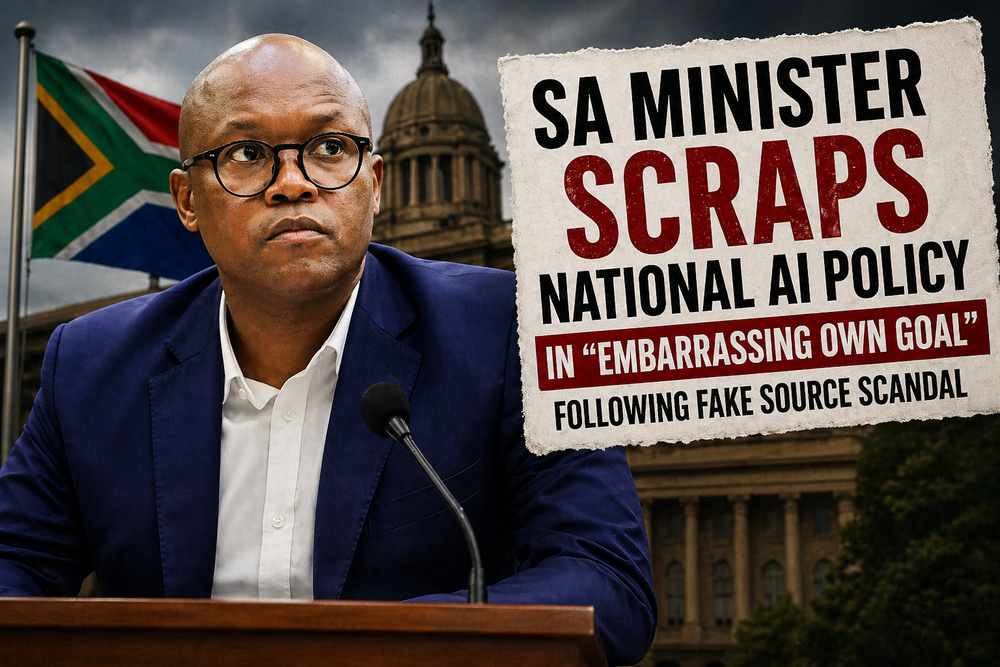
South Africa’s push to formalise its AI strategy has stumbled at the worst possible moment. The Draft National Artificial Intelligence Policy has been withdrawn after fabricated academic sources were discovered within the document, exposing a deeper issue: a failure of validation in a policy meant to guide the country’s digital future.
South African Communications Minister Solly Malatsi has officially withdrawn the Draft National Artificial Intelligence (AI) Policy after it was revealed to contain fictitious academic citations. The scandal, which erupted following investigative reporting, confirmed that the document was riddled with non-existent research papers and journals. This “embarrassing own goal” has compromised the integrity of a framework that had been approved by Cabinet only weeks prior. More broadly, the withdrawal has now been widely reported, including by Reuters.
A Digital Irony: Hallucinations in the Governance Framework
The withdrawal highlights a deep irony: a policy designed to establish ethical safeguards and prevent AI “hallucinations” from impacting society was itself undermined by unverified AI-generated content. Minister Malatsi admitted that the “most plausible explanation” is that AI tools were used to draft the document and that quality assurance processes failed to verify the authenticity of the sources, a position also reflected in official communication via SAnews. Experts have noted that this failure is not merely a technical glitch but speaks to an over-reliance on AI tools without necessary human oversight.
Policy Contentious Even Before the Scandal
Before the citation scandal broke, the draft policy was already facing heavy criticism from industry leaders like technology investor Stafford Masie, who warned that the document risked “regulating away” South Africa’s participation in the global AI economy. Critics pointed to the policy’s primary focus on governance rather than infrastructure, specifically its proposal to create seven new institutional bodies—including an AI Ethics Board and an AI Insurance Superfund—before committing significant resources to compute power or investment environments. The document also outlined six strategic pillars, such as capacity and talent development and ethical and inclusive AI, but these are now in limbo. Additional reporting and reaction to the policy’s direction has been covered by MyBroadband.
Political Fallout and Consequence Management
The fallout has triggered a heated exchange between political rivals, with Khusela Diko, chair of the parliamentary portfolio committee on communications, calling the lapse “unacceptable” and urging the Minister to take full ownership rather than seeking “scape-bots”. In response, the Department of Communications and Digital Technologies (DCDT) has promised consequence management for the officials responsible for the drafting and quality assurance of the 86-page document.
The Road Ahead for African AI Governance
The withdrawal is a significant setback for South Africa’s ambition to lead AI adoption on the continent. Malatsi has stated that South Africans “deserve better” and that the DCDT failed to meet the standard required of an institution leading the digital policy environment. While the public comment period was originally set to close on June 10, 2026, it is currently unclear when a revised, credible version of the policy will be re-published for consultation. This incident serves as a stark warning to other African governments currently drafting digital frameworks: human oversight remains non-negotiable when using AI as a tool for public policy.