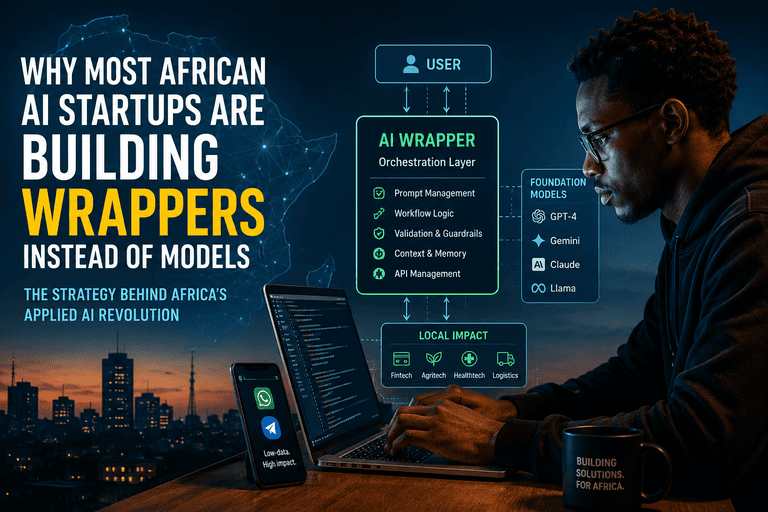
The African technology ecosystem is undergoing a distinctive structural shift away from the capital-intensive pursuit of frontier foundation models toward the development of specialized AI wrappers.
An AI wrapper is a software orchestration layer that sits between a foundation model—such as OpenAI’s GPT-4 or Google’s Gemini—and the end user, managing API calls and workflow logic to make the model usable for specific tasks. This strategy is not a sign of technological catch-up but a rational strategic response to the unique socio-economic, infrastructural, and financial realities of the continent.
1. The Infrastructure Barrier: Power and Compute
The most immediate driver of the wrapper strategy is Africa’s significant macro-infrastructural constraints. Training foundational models requires immense, stable power and massive high-performance computing (HPC) hardware that is currently scarce on the continent.
- The “Diesel Tax”: Many African technology hubs must rely on diesel generators because national grids are often incapable of meeting the high-density demand for data centers. This reliance on fossil fuels inflates operational expenses by 30% to 50%, making local model training economically unviable.
- Hardware Scarcity: Specialized chips like the NVIDIA H100 GPU are estimated to be ten times harder to acquire in Africa than in the United States. High import tariffs and duties can add up to 60% to the cost of a single unit, which already carries a staggering market price of $30,000 to $45,000.
- Capacity Gap: While Africa’s data center market is growing, the continent currently accounts for only 0.6% to 1% of the world’s total storage and processing capacity.
2. The Applied AI Imperative: Unit Economics over Research
The financial structure of the African venture capital (VC) ecosystem dictates a focus on operational efficiency over speculative frontier research.
- Classification Gaps: AI funding in Africa is frequently undercounted because it is often hidden within the Fintech, Healthtech, or Logistics sectors. When a company like Moniepoint uses machine learning to underwrite loans for 70,000 Nigerian businesses, it is categorized as fintech rather than AI.
- Unit Economics: African startups are priced on their ability to solve immediate problems—such as reducing loan underwriting time from weeks to minutes—rather than the promise of achieving general intelligence.
- Lower Barrier to Entry: Building a wrapper allows founders to reach monthly recurring revenue (MRR) quickly enough to fund more substantial product development.
3. Solving the “Last Mile” of Local Relevance
Foundational models are predominantly trained on Euro-American data, which often lacks the cultural and linguistic context required for the African market.
- The Language Problem: There are over 2,000 languages spoken in Africa, yet only 0.02% of internet content is available in African languages. General-purpose models struggle with tonal variations in languages like Igbo or the morphological richness of Bantu languages like Swahili.
- Vertical Customization: Wrappers solve the “last mile” of AI deployment by ensuring that model outputs are relevant to specific users, such as a farmer in rural Kenya using an agritech platform to detect crop disease.
- Mobile-First Integration: Since most Africans access the internet via mobile phones, successful wrappers often integrate with widely used low-data platforms like WhatsApp and Telegram.
4. The Evolution from “Thin” to “Thick” Wrappers
While critics dismiss many startups as “just a wrapper,” the most successful African companies are building “thick wrappers“ with deep defensive moats.
- Case Studies:
- Curacel: An insurance infrastructure that identifies fraud patterns 12x better than manual systems by applying business logic to structured data.
- Leta: A logistics optimizer that uses AI to cut mileage by 10% to 20% and fuel costs by 20%.
- Gebeya Dala: A “vibe coding” platform that uses an orchestrator layer to intelligently route user prompts to the most suitable underlying model.
5. The Sovereignty Gap: “Rented Intelligence”
Because African AI startups primarily “rent” intelligence from Global North providers via APIs, they face significant sovereignty risks.
- Overseas Hosting: Scarcity of local infrastructure forces African AI workloads onto foreign servers, subjecting local data to external jurisdictions and potential exploitation—a phenomenon sometimes described as “digital colonialism”.
- Economic Rent: Without local foundations, African startups continually “pay rent” to external providers, which is increasingly viewed as a new frontier of economic injustice.
6. Policy Responses and Sovereign AI Initiatives
To counter this dependency, several African nations are implementing sovereign AI mandates and infrastructure projects:
- AI Factories: Partnerships like the one between Cassava Technologies and NVIDIA aim to launch supercomputing “AI factories” in South Africa, Nigeria, and Kenya to enable model training while keeping data within African borders.
- Compute Nodes: The UNDP’s timbuktoo initiative is setting up AI Compute Nodes powered by renewable energy to provide local startups with GPU capacity closer to the communities they serve.
- Linguistic Sovereignty: Labs like Lelapa AI and projects like Masakhane are building small language models (SLMs) and inclusive corpora to challenge “epistemic colonialism”.
- Data Licensing: The Noodl License ensures that data derived from African communities respects cultural and intellectual property rights, keeping ownership in local hands.
Conclusion: A Resilient Strategy for the Intelligence Age
The prevalence of AI wrappers in Africa is not a symptom of low ambition but a rational, adaptive response to an environment of infrastructural scarcity. By focusing on the application layer, African builders are fundamentally reshaping finance, agriculture, and logistics. As the global AI market matures, Africa’s strength will likely reside in its ability to deploy applied intelligence where it matters most, while simultaneously building the “sovereign pipes”—locally owned data centers, renewable energy, and indigenous datasets—to ensure a truly independent digital future.