
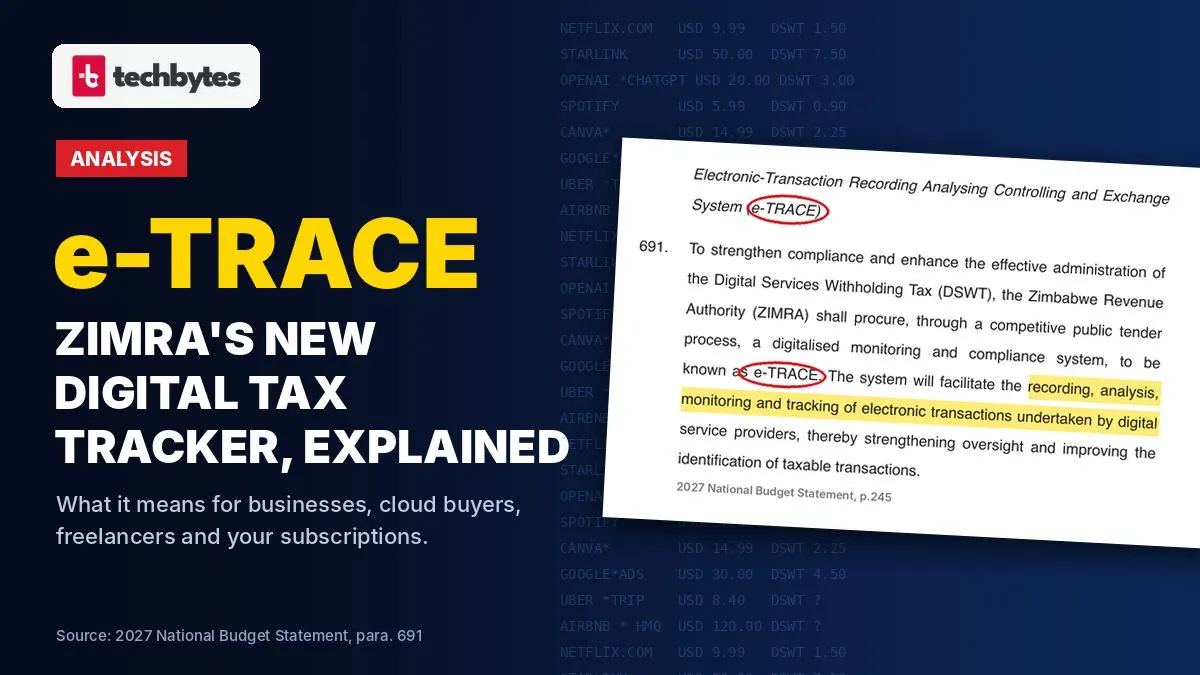
Since January, Zimbabweans have paid a 15.5% tax on almost every payment to a foreign digital service, from Netflix and Starlink to cloud servers and ChatGPT. Many businesses found ways around it. ZIMRA now plans to close those gaps with a monitoring system called e-TRACE, announced in the 2027 National Budget Statement (paragraph 691).
For businesses, that turns avoidance into exposure. For everyone else, it means a government system built to record what Zimbabweans pay for online. And under Zimbabwe’s data protection law, there’s very little standing in its way.
The tax e-TRACE is built to police
The Digital Services Withholding Tax (DSWT) took effect on 1 January 2026. It’s 15.5% on payments to foreign digital service providers. The Budget lists the categories: online marketplaces and platforms, social media, data transmission, digital content, cloud computing, online teaching, online gambling, streaming and e-hailing. Banks and mobile money platforms add it at the moment of payment and pay it to ZIMRA.
It doesn’t apply to local transfers, to Zimbabwean providers, or to physical goods bought online. Those still pay duty and VAT at the border.
The weakness has always been collection. ZIMRA sees only what local banks report. If a payment doesn’t pass through a Zimbabwean bank, no tax is deducted.
The workaround, and what e-TRACE changes
Businesses have avoided the tax in predictable ways: paying with cards from a South African subsidiary, a director’s offshore account or a relative abroad; using foreign virtual cards; prepaying annual subscriptions before January; or paying agents in cash to settle bills for them. Each of these works only because no Zimbabwean bank sees the payment.
The Budget says e-TRACE will “facilitate the recording, analysis, monitoring and tracking of electronic transactions undertaken by digital service providers.” It comes with three related plans:
- Data sharing with banks, “through an appropriate data-sharing framework” (paragraph 690).
- Taxing where the users are. Revenue will be attributed to Zimbabwe “based on user location,” and foreign providers will be helped to register and file returns here (paragraphs 694 to 695).
- Stronger enforcement against non-resident operators and “artificial business restructuring” (paragraph 696).
Together, these give ZIMRA a view of digital transactions from the providers’ side, not only from the banks’. Once ZIMRA can see that a foreign provider billed a Zimbabwean customer, a foreign card no longer hides the payment.
What it really costs: a simple rule
A payment to a foreign digital provider through a local bank or wallet costs the bill plus about 17.5%: 15.5% DSWT, plus IMTT, which falls to 1.75% on US dollar transactions from January. Bank, card or wallet fees come on top.
| Monthly foreign digital spend | DSWT | IMTT (1.75%) | Total paid | DSWT per year |
|---|---|---|---|---|
| $10 | $1.55 | $0.20 | $11.75 | $18.60 |
| $50 | $7.75 | $1.01 | $58.76 | $93 |
| $1,000 | $155 | $20.21 | $1,175.21 | $1,860 |
| $4,000 | $620 | $80.85 | $4,700.85 | $7,440 |
| $10,000 | $1,550 | $202.13 | $11,752.13 | $18,600 |
IMTT is calculated on the bill plus DSWT, the total leaving the account.
For businesses: avoidance becomes exposure
- Unpaid DSWT doesn’t disappear. Under most withholding tax rules, when tax isn’t withheld, the authority can assess the payer. A business that routed payments abroad could owe 15.5% of every foreign digital payment since January 2026, plus penalties and interest. The last column of the table is that exposure.
- Expenses without a clean paper trail are at risk. A company bill paid on a relative’s foreign card is hard to prove as a company expense. In an audit, the deduction itself could be challenged.
- Your books have to match what ZIMRA can see. Payments, invoices and DSWT should line up for every foreign provider.
- Getting the classification wrong is now your problem. Vendors that sell both services and goods are where mistakes happen.
AI subscriptions: the new cost centre nobody budgeted for
Cloud isn’t the only foreign bill. In 2026, Zimbabwean companies signed up for ChatGPT, Claude, Gemini, Microsoft Copilot, Midjourney and dozens of AI writing, design and coding tools. All of them are foreign digital services, and all attract 15.5%.
Three problems stand out:
- Usage-based billing adds up. Companies building products on AI models pay per use. A startup spending US$2,000 a month on an AI API pays about US$310 a month in DSWT on what is often its single biggest cost.
- AI subscriptions are where foreign-card habits are worst. AI tools are often adopted by staff before IT or finance approves them, and paid on personal or foreign cards. That’s exactly the kind of spending e-TRACE is designed to find, and it often has no company paperwork behind it.
- There’s also a data protection problem. When staff paste customer details into a foreign AI tool, that’s a transfer of personal data out of Zimbabwe. The Cyber and Data Protection Act restricts transfers to foreign countries unless the recipient’s country ensures “an adequate level of protection.” Companies cleaning up their AI spending for tax should check what data is going into those tools at the same time. (We looked at this in When your conversations with Claude leave the continent.)
Where it compounds: local resellers
Many businesses buy cloud and software through a local IT company that resells it. The reseller pays the foreign bill plus DSWT plus IMTT, adds its margin, then charges 15.5% VAT on the total. VAT is charged on a price that already includes DSWT: tax on tax.
With a 20% reseller margin, a client that isn’t VAT-registered pays about 1.41 times the foreign list price without DSWT, and about 1.63 times with it. A VAT-registered client can reclaim the VAT, but the DSWT built into the price can’t be reclaimed.
For the ordinary person
You don’t need a business to feel this. If you pay through a local bank or mobile wallet, here’s where it shows up:
- Streaming. Netflix, Spotify, Apple Music, YouTube Premium and similar services are all on the list. A US$10 plan costs about US$11.75, which is US$18.60 a year in DSWT alone.
- Starlink. The kit is a physical good, so it pays duty and VAT at the border, not DSWT. The monthly subscription is a digital service, so it attracts 15.5%. On a US$50 plan, that’s US$93 a year.
- inDrive. E-hailing is on the list. Most riders in Zimbabwe pay drivers in cash, which the tax doesn’t touch. But drivers pay the platform’s commission, and when they pay it by card or wallet to a foreign platform, it attracts DSWT. Expect that cost to show up in fares.
- Cloud storage and apps. iCloud and Google storage, app store purchases, and in-game purchases are all digital content or cloud services.
- Online betting. Online gambling is on the list too.
The rule for households is the same: about 17.5% on top, plus your bank or wallet’s fees. Three or four subscriptions can easily cost a family more than US$100 a year in DSWT.
Your privacy: what monitoring means at a personal level
This is the part with the biggest long-term consequences.
A record of what you pay for online is a record of your life. It shows what you watch, which AI tools you use, whether you bet, which dating or health apps you pay for, which faith or political content you subscribe to, and when you use a VPN. The Budget describes e-TRACE as tracking “transactions undertaken by digital service providers.” It doesn’t say whether the system will hold data about individuals, but bank-level data sharing and attribution “based on user location” both point that way.
What the law says. Zimbabwe’s Cyber and Data Protection Act (CDPA) makes POTRAZ the Data Protection Authority. Banks are data controllers, and your transaction history is personal data. In fact, the Act lists “financial history” as sensitive data (section 3), which normally can’t be processed without your written consent (section 11(1)).
Why e-TRACE will still go through. The Act has clear exceptions:
- Non-sensitive data can be processed without consent where necessary for “compliance with an obligation to which the controller is subject by or by virtue of a law” (section 10(3)(b)), or for “performing a task carried out in the public interest, or in the exercise of the official authority vested in the controller” (section 10(3)(d)).
- Sensitive data can be processed without consent where “the processing of data is authorised by a law or any regulation for any other reason constituting substantial public interest” (section 11(5)(h)).
- Even your right not to be subject to decisions based solely on automated processing, “including profiling,” doesn’t apply where the decision is “based on a provision established by law” (section 25).
Tax collection is a legal obligation and a public interest task. Once Parliament or the Minister gives e-TRACE a legal basis, banks will be required to share, and your consent won’t be needed. The CDPA won’t stop it.
The safeguards that remain:
- Purpose limitation. Data must be collected for “specified, explicit and legitimate purposes” and not reused in incompatible ways (sections 9 and 13). Data collected for tax shouldn’t be used for anything else.
- Collecting only what’s needed. Data must be “limited to what is necessary” (section 13(d)). ZIMRA needs to know a payment went to a foreign digital provider. Whether it needs to know which film or which app is a fair question.
- Retention limits. Data can’t be kept “for no longer than is necessary” for its purpose (section 13).
- Notifying POTRAZ. Before automated processing starts, the controller must notify the Authority, and the notice must state “the law or regulatory instrument permitting the automatic processing of data” (sections 20 and 22).
- Breach reporting. Any security breach must be reported to POTRAZ within 24 hours (section 19).
- Your right to be informed of how your data is used (section 14).
The catch right now. The legal basis isn’t there yet. The data-sharing framework and user-location rules appear in the Budget Statement, which isn’t law, and they aren’t in the draft Finance Bill. Until a law or regulation authorises the sharing, banks that hand over customer-level data would be on weaker ground under the CDPA. That gives the public a window to ask for safeguards before the legal basis is written.
What should be written into it: what data e-TRACE collects; whether it holds individual-level or only provider-level data; who at ZIMRA can access it; how long it’s kept; whether it can be shared with other agencies; and how ZIMRA will meet POTRAZ’s notification and breach rules. The tender documents should answer all of these.
The positives
- Local providers become more competitive with business buyers. A VAT-registered business can reclaim 15.5% VAT charged by a local provider, but can’t reclaim 15.5% DSWT on a foreign one. For those buyers, local cloud, hosting and software are effectively 15.5% cheaper.
- The double-tax fix. Services where DSWT has been withheld will be exempt from VAT (paragraph 689).
- Fair competition. Businesses that comply are no longer undercut by those routing payments abroad.
- Clarity on goods. The Budget states that DSWT “shall not apply to the purchase of goods through digital platforms” (paragraph 692).
- Revenue from foreign platforms that earn from Zimbabwean users and pay little here.
The negatives
- It taxes the tools businesses use to produce, including cloud, software, ads and now AI.
- Zimbabwean firms pay more than regional competitors. In South Africa, foreign digital providers charge VAT that local businesses can reclaim. A Zimbabwean firm pays 15.5% it can’t get back.
- Tax on tax in reseller chains.
- “Buy local” isn’t possible for most of it. There’s no local equivalent of hyperscale cloud, global ad platforms or leading AI models.
- Compliance costs fall hardest on small firms.
- Personal spending becomes a state record, with the CDPA unable to block it once a law authorises it.
- Nothing is known about e-TRACE itself. The Budget gives no cost, timeline, specification or data protection terms. Contracts above US$2 million need Treasury approval before signing, under Treasury Circular 10 of 2025 (Budget speech, paragraph 101).
- No figure on what DSWT has raised in 2026, and none of the promised fixes are in the draft Finance Bill yet.
What to do now
Businesses
- Audit every foreign digital payment since 1 January 2026, including AI tools paid on staff cards.
- Quantify your exposure and get advice on voluntary disclosure.
- Move recurring foreign bills onto company accounts at local banks.
- Write an AI use policy covering what data staff may put into foreign AI tools.
- Price the 15.5% into contracts, and compare local providers.
Individuals
- Check your statements to see what you actually pay, and cancel the subscriptions you don’t use.
- Ask your bank what transaction data it shares with ZIMRA, and how you’ll be informed. You have a right to know under section 14 of the CDPA.
The bottom line
e-TRACE is good for tax fairness and for local providers. It’s bad for the cost of doing digital business, and it marks a real shift in how much the state can see of ordinary people’s digital lives. Zimbabwe’s data protection law gives way to tax law by design. So the protection Zimbabweans get will depend on what the legal basis for e-TRACE says, and that hasn’t been written yet. Now is the time to push for limits on what it collects, how long it keeps it, and who can see it.
Related reading on TechBytes