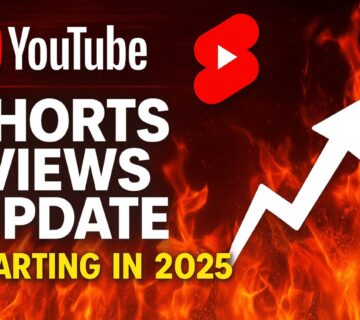
YouTube published changes to its Partner Programme on 10 August. Most coverage has led with one number: new creators will need 8,000 qualified watch hours instead of 4,000, or 20 million Shorts views instead of 10 million, from 1 February 2027.
That is the least consequential of the three changes announced, and it does not affect anyone already earning.
Read the announcement carefully and a different structure emerges. One change takes revenue away from creators who currently receive it, worldwide, including in Zimbabwe. A second offers new earning routes in exchange. Those routes run on YouTube products that are not available in Zimbabwe, or anywhere else on the African continent.
What was actually announced
Three items, in YouTube’s own ordering.
Premium Lite is expanding to every country where YouTube Premium is sold. Creators earn from subscriptions through dedicated revenue pools: 30 per cent of net subscription revenue for Premium, and 60 per cent for Premium Lite. Each pool is distributed according to member watch time and views, then split 55 per cent to long form video and 45 per cent to Shorts.
Shorts revenue is being gated. From 1 February 2027, a channel needs 10 million qualified Shorts views over the preceding 90 days to be eligible for ads and subscription revenue sharing on Shorts. Channels below the line remain in the Partner Programme and continue earning from long form content, and Shorts revenue sharing resumes automatically if they cross back over 10 million.
Entry thresholds are doubling for new applicants only. 8,000 qualified watch hours in 365 days, or 20 million qualified Shorts views in 90 days. Fan funding and shopping entry thresholds are unchanged.
The distinction that most coverage has blurred is this: the entry change spares existing members, and YouTube says so explicitly. The Shorts gate does not. It applies to everyone in the programme once it starts.
For a Zimbabwean channel currently receiving a small monthly Shorts payment, the entry threshold story is irrelevant and the Shorts gate is the whole story.
What is offered in exchange
YouTube is candid that the Shorts gate will cut some channels out, and it names what those channels get instead. For channels below the 10 million view threshold, it points to bonuses for YouTube Shopping, incentives for brand deals, and earnings boosts for starting and growing trends. Details, it says, will follow.
Two of those three are existing YouTube products with published country lists.
The YouTube Shopping affiliate programme, according to YouTube’s own help documentation, is available to creators based in Argentina, Brazil, India, Indonesia, Japan, Korea, Malaysia, Mexico, the Philippines, Singapore, Taiwan, Thailand, the United States and Vietnam. The United Kingdom was added on 6 August 2026, bringing the programme to fifteen countries.
No African country is on that list. Zimbabwe is not on that list.
The Creator Partnerships brand deal tools, which sit inside YouTube Studio, were extended in July 2026 to the United Kingdom, Germany, Japan and Singapore. Also not Zimbabwe, and not Africa.
So the structure of the trade, as it currently stands, is that the reduction applies globally and the compensation applies in fifteen markets.
A Zimbabwean creator below 10 million Shorts views per quarter loses a revenue line on 1 February 2027 and is offered, in its place, bonuses attached to a shopping programme they cannot join and incentives attached to brand deal tooling they cannot access.
This may change. YouTube has said more detail is coming, and it has expanded Shopping steadily through 2026, from twelve countries in March to fifteen in August. Whether that expansion reaches Africa before February 2027 is not stated anywhere in the announcement, and the announcement is the only thing creators can plan against.
The Premium Lite question
The Premium Lite expansion is the genuinely positive element, and Zimbabwe should be inside it. YouTube Premium became available in Zimbabwe in March 2024, alongside Tanzania, Uganda, Libya and Morocco. If Premium Lite goes everywhere Premium is sold, it goes to Zimbabwe.
The proportions are worth noting. YouTube allocates 60 per cent of Premium Lite net subscription revenue to the creator pool, against 30 per cent for full Premium. Per subscriber, Premium Lite is the more generous arrangement for creators, which is a reasonable trade for a cheaper tier likely to convert more subscribers in price sensitive markets.
But the split inside that pool is 55 per cent long form and 45 per cent Shorts, and the Shorts allocation is subject to the same 10 million view gate. YouTube’s wording ties the threshold to ads and subscription revenue sharing on Shorts, not ads alone.
Which means a Zimbabwean channel built primarily on Shorts, and many are, because Shorts are cheap to produce and travel further on distribution than a local audience alone would carry them, would be eligible for a share of the long form 55 per cent and shut out of the 45 per cent.
New money arriving in the Zimbabwean market, with the Shorts half of it behind a gate most local channels cannot clear.
The direction of travel
Strip out the numbers and the announcement points one way: towards long form video, towards durable audiences, and away from volume Shorts production.
8,000 watch hours is now considerably easier to reach than 20 million Shorts views. Long form gets the larger share of the subscription pool. Shorts revenue is gated and long form revenue is not.
For creators in a market like Zimbabwe, that is a shift towards the more expensive form. Long form needs more shooting time, more editing, better equipment, more bandwidth to upload, and an audience willing to give sustained attention rather than a scroll. Shorts were the accessible route, and the accessible route is the one being narrowed.
The counter argument deserves stating. YouTube’s position is that it expects to pay creators more in total in 2027 than in 2026, that the changes reward active creators, and that creators already earning meaningful Shorts revenue are unlikely to be affected. All three may be true. A programme with more than 3 million participants can grow its total payout while redistributing it away from the smallest channels, and both statements can be accurate at once. Which of those two facts matters to you depends entirely on which end of the distribution you occupy.
What we cannot tell you
How many Zimbabwean channels are in the Partner Programme. How many clear 10 million Shorts views in a quarter. How much Zimbabwean creators currently earn from Shorts against long form.
None of this is published, by YouTube or by anyone else. Zimbabwe’s creator economy is discussed constantly and measured never, which means every claim made about it, including the cautious ones in this article, rests on inference rather than data.
We are working on that. In the meantime, if you create on YouTube from Zimbabwe and you have visibility of your own numbers, we would like to hear from you.
What to do before February
Check your Shorts views over the last 90 days in YouTube Studio. That single figure tells you whether the gate applies to you.
If you are close to the line, you have roughly six months to establish whether you can hold above it.
If you are well below it and Shorts revenue is a meaningful part of your income, treat that line item as ending on 1 February 2027 and plan on that basis rather than on the promised incentive programmes, none of which currently operate in this country.
If you are not yet in the Partner Programme, the entry thresholds do not change until 1 February 2027. Applications approved before that date are assessed against the current 4,000 hour and 10 million view requirements.
Existing members must review and sign the new terms in YouTube Studio. They take effect on 1 February 2027.