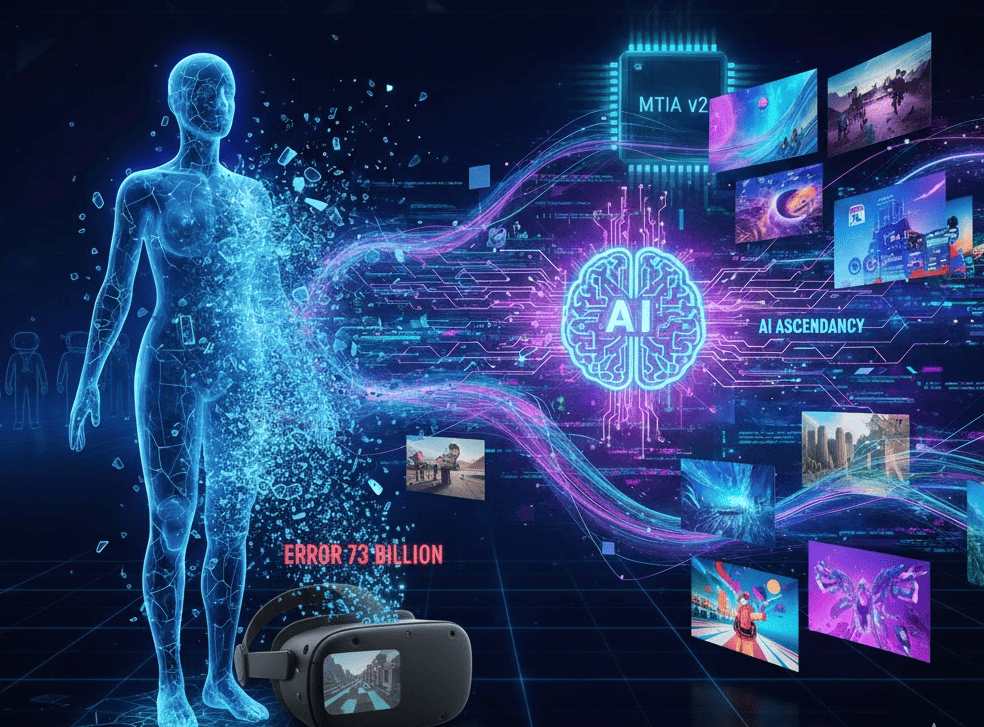
Meta’s high-stakes gamble on the metaverse is being rewritten in real-time. What began as a 2021 rebrand fueled by visions of a legless virtual utopia has hit a financial and social wall, leading to a massive strategic retreat toward generative artificial intelligence. For tech leaders and investors, the story is no longer about “the next stage of the internet” but about the brutal lessons of efficiency, leadership, and human biology.
The Anatomy of a $73 Billion Failure
The scale of the metaverse’s failure is staggering. By early 2025, cumulative losses for the Reality Labs division reached an estimated $73 billion. This was not just a hardware problem; it was a fundamental failure of execution and strategy.
- “Employee Bingo” and Leadership Chaos: Insiders describe the division as “dysfunctional,” characterized by frequent leadership reshuffling. High-level “local heroes” from divisions like Instagram were promoted to lead VR teams despite lacking any technical expertise in AR/VR—a practice described by former staffers as “playing employee bingo” with roles they didn’t understand.
- The “Architecture Astronaut” Trap: Former Oculus CTO John Carmack warned that the project was a “honeypot trap for architecture astronauts”—programmers and designers who focused on broad, high-level concepts while ignoring the “logistical nuts and bolts” required to build a functional product.
- A “Barren” World: The flagship social platform, Horizon Worlds, failed spectacularly to retain users. Internal documents revealed that most users never returned after the first month, and only 9% of virtual worlds were ever visited by more than 50 people. By mid-2023, daily active users had plummeted, at one point potentially falling below 1,000.
- The Quest Pro Commercial Disaster: Marketed as a high-end productivity tool for $1,500, the Quest Pro was a commercial failure. It suffered from grainy passthrough and underwhelming resolution, leading Meta to slash the price by $500 just four months after launch before eventually halting production.
The Biological Wall: Cybersickness
Perhaps the most overlooked reason for the failure was human biology. Research indicates that 30% to 80% of users suffer from “cybersickness” (nausea, dizziness, and eye strain) in VR.
Crucially, studies found that technical fixes like higher resolution have a minimal impact compared to a user’s personal susceptibility to motion sickness. This means that no matter how much Meta spent on hardware, a significant portion of the global population was biologically excluded from the “Metaverse” experience from day one.
The Pivot: Why AI and Why Now?
The Llama Gambit: Seizing the “Linux of AI”
Zuckerberg’s retreat from the Metaverse isn’t a white flag—it’s a scorched-earth offensive. By late 2025, Meta realized that if they couldn’t own the hardware of the future (the VR goggles), they had to own the intelligence that runs on everyone else’s hardware.
1. The Open-Source “Tsunami”
While OpenAI and Google built “walled gardens” for their AI, Meta unleashed Llama 4. By making their most powerful models (like the Maverick and Scout variants) open-weight, Meta effectively commoditized the competition.
-
The Strategy: If AI is free and open, developers won’t pay for OpenAI’s APIs.
-
The Result: By early 2026, over 2.2 million derivatives of Llama were hosted on Hugging Face. Meta didn’t just join the race; they blew up the track, forcing the entire industry to build on their foundation.
2. From “Friends” to “Personal Superintelligence”
The pivot has killed the “Social Graph.” The era of seeing what your high school friends had for lunch is over.
In its place is the “Interest Graph”—a relentless, generative feed where AI doesn’t just recommend content, it hallucinates it for you. This is the “Vibes” era:
-
The Feed is Dead: Instead of a list of posts, your screen is a continuous, AI-generated stream of media tailored to your dopamine receptors in real-time.
-
The New Ad-War: By using the Meta-Lattice algorithm, Meta has bypassed Apple’s privacy walls, predicting user intent with such terrifying accuracy that ad click-through rates have surged by 19%, even as traditional tracking remains broken.
3. The $40 Billion Hardware Flex
Meta isn’t just a software company anymore. To run these “Personal Superintelligences,” Zuckerberg has sanctioned a $40 billion annual spend on AI infrastructure.
-
The Prometheus Cluster: Meta’s first gigawatt-scale AI supercluster is coming online in 2026, powered by their custom MTIA v2 chips.
-
The Endgame: By slashing the unit cost of AI compute by 60%, Meta can afford to give away for free what others must sell to survive.
The Takeaways: Lessons for the Tech Ecosystem
- Innovation requires expertise: Promoting successful leaders from one domain (social media) into a fundamentally different one (spatial computing/VR) can lead to catastrophic mismanagement.
- Infrastructure over hype: Meta’s pivot is anchored in hardware self-sufficiency (MTIA chips) rather than purely conceptual virtual real estate.
- Human limits are real: Tech adoption is not just about Moore’s Law; it is limited by human physiological factors like cybersickness that software cannot easily “patch”.
- The Feed is evolving: The industry is moving from recommending content to generating it. The next social media war will be won by whoever builds the best generative content models, not the best virtual malls.
Meta’s $73 billion lesson is clear: A “mass hallucination” of the future cannot replace a product that people actually want to use today. By refocusing on AI-driven efficiency, Meta is betting that the future of social media isn’t where we go, but what the algorithms create for us.