By Techbytes Africa Staff
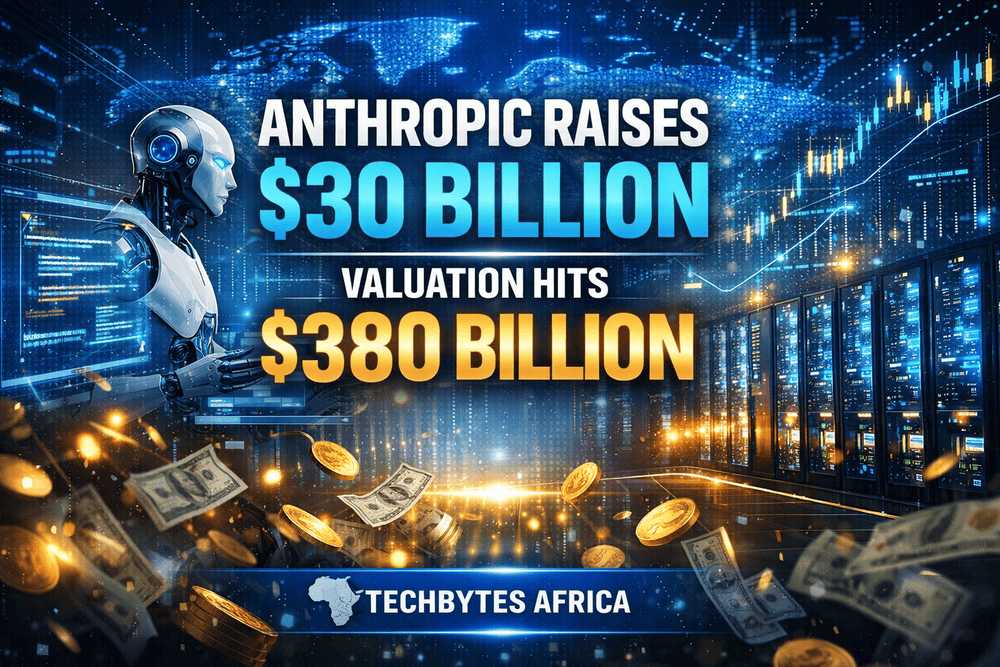
In a move that has sent shockwaves through the global technology sector, Artificial Intelligence heavyweight Anthropic has announced it has closed a massive $30 billion Series G funding round. The deal more than doubles the company’s valuation to $380 billion in just five months and now stands as the second largest private technology fundraise in history, surpassed only by OpenAI’s $40 billion round last year.
The funding was led by Singapore’s sovereign wealth fund GIC and hedge fund Coatue Management, with a list of participants that reads like a roster of global financial powerhouses. Co leads included Founders Fund, D.E. Shaw Ventures, Dragoneer, ICONIQ, and Abu Dhabi backed MGX. Technology giants Microsoft and Nvidia also contributed as part of their broader strategic commitments to the company.
The Fastest Scaling B2B Company in History?
Beyond the staggering valuation, the metrics released alongside the raise reveal a growth trajectory rarely seen in enterprise software.
Anthropic disclosed that its annualized revenue run rate has reached $14 billion. Just fourteen months ago, in December 2024, the company was at roughly $1 billion ARR. This represents a tenfold increase sustained over three consecutive years.
Analysts now describe Anthropic as the fastest scaling B2B company in the history of software, surpassing the growth curves of companies such as Slack, Zoom, and Snowflake during their peak expansion periods.
A major driver of this growth has been Claude Code, an AI powered coding agent launched to the public in May 2025. The product alone has reached $2.5 billion in annualized revenue. Its adoption is so widespread that it is estimated to author around four percent of all public GitHub commits, effectively one in every twenty five pieces of code pushed to the platform.
The Two Trillion Dollar AI Shockwave
Anthropic’s rise is occurring alongside a dramatic repricing of the traditional software industry. Investors are rapidly adjusting expectations as AI agents begin to automate functions that were previously core to high value SaaS offerings.
Software companies have collectively lost an estimated two trillion dollars in market capitalization from their peak valuations as AI expands into specialised enterprise verticals.
Recent examples illustrate the speed of disruption. The launch of a Claude cowork plugin for legal workflows triggered immediate sell offs in legal software stocks. Similar pressure is emerging in financial services and healthcare sectors where Anthropic is deploying compliance ready AI tools for administrative and operational processes.
According to CFO Krishna Rao, enterprise demand remains the dominant revenue engine, with around eighty percent of income coming from corporate buyers. Anthropic reports that eight of the Fortune ten companies are now among its customers.
The End of Venture Capital Exclusivity
The massive capital requirements of frontier AI are also reshaping long standing venture capital norms.
Historically, investment firms avoided backing direct competitors. That pattern is now dissolving. Major investors such as Sequoia Capital, Blackstone, and JPMorgan now hold positions in both Anthropic and OpenAI.
Industry insiders suggest the logic is straightforward. The cost of missing a generational technology company now outweighs the discomfort of funding rival firms simultaneously.
IPO Preparations Underway
Despite its private status, Anthropic is already positioning itself for a public market debut. Reports indicate the company has engaged law firm Wilson Sonsini to begin IPO preparations, with a listing potentially taking place as early as late 2026.
The company also claims to be on a path toward financial sustainability. It forecasts reducing cash burn to nine percent of revenue by 2027 and aims to reach break even by 2028, reportedly ahead of OpenAI’s projected timeline.
For now, the $30 billion capital injection provides the war chest required to sustain the immense compute demands of training and deploying next generation AI systems.
What This Means for Africa’s Tech Sector
Anthropic’s record breaking raise is not just another Silicon Valley milestone. It is a signal that the global technology economy is shifting faster than many markets are prepared for, including those across Africa.
The most immediate impact will be felt by companies whose business models rely heavily on human labour as their primary value driver. Large portions of Africa’s technology services sector still depend on billing for development hours, outsourced support, and operational management. AI agents are now directly targeting these functions.
If AI coding systems can produce production ready software in minutes, the economics of traditional software development firms change fundamentally. The same pressure will extend into legal research, financial analysis, customer support, and administrative operations, sectors that employ hundreds of thousands across the continent.
Capital markets are also adjusting. Global investors are shifting funding toward AI infrastructure and platform companies, leaving conventional SaaS startups facing tougher fundraising conditions and valuation scrutiny.
At the same time, this shift presents a strategic opportunity for telecommunications operators. AI models require enormous compute power and reliable energy infrastructure. Telcos that control fibre networks, data centres, and regional connectivity are uniquely positioned to become the backbone of Africa’s emerging AI economy.
The uncomfortable reality is that policy frameworks across much of the continent remain unprepared for the speed of this transition. Many national digital strategies still assume gradual technological change. The rapid integration of AI agents into enterprise workflows suggests disruption could arrive far sooner than expected.
The global debate about whether AI will reshape business is already settled. The real question for African leaders is whether they will act early enough to shape its impact or spend the next decade reacting to decisions made elsewhere.