In 2025, the global artificial intelligence landscape was shaped not just by new models and products, but by how tech giants deployed capital — buying companies, talent, and stakes — to secure strategic advantage. Acquisitions have intensified competition; acqui-hires and licensing deals have locked in specialized talent and IP; and deep investments have forged influence without full ownership.
Below, we map the key transactions by major AI players — Meta, Nvidia, OpenAI, Google/Alphabet, Microsoft, xAI/X, and others — into three clear categories: (1) Purchases (full acquisitions/mergers), (2) “Acqui-hires” / licensing/talent deals, and (3) Investments / strategic stakes.
1. Purchases: Full Acquisition and Mergers
Meta
-
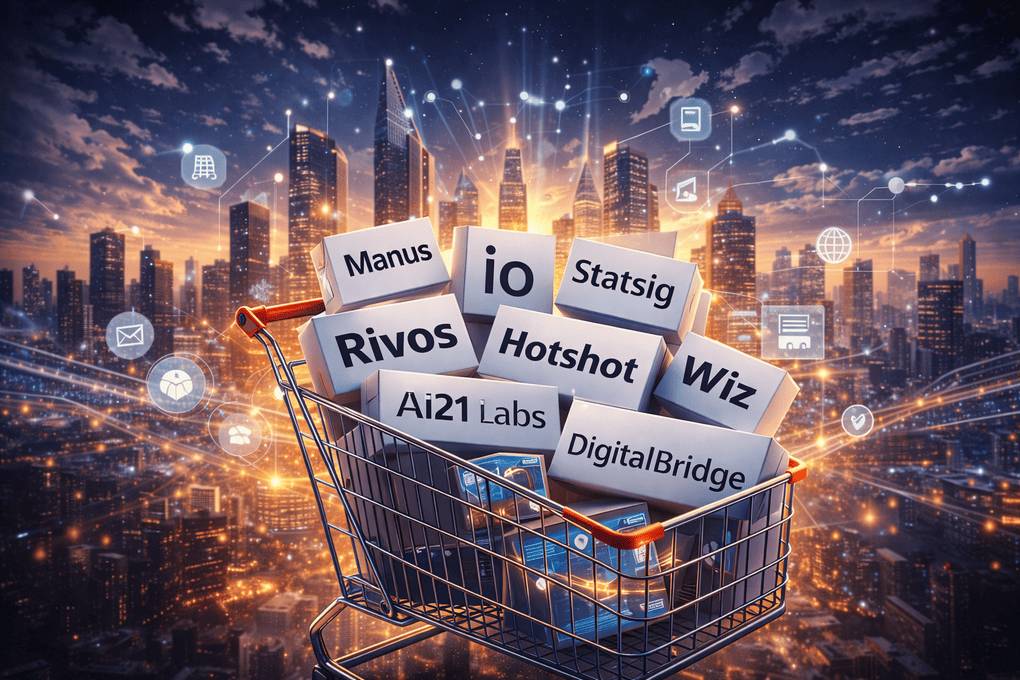
Manus – Meta acquired the Singapore-based AI startup known for autonomous general-purpose AI agents in late December 2025 for an estimated $2–3 billion. This represents one of Meta’s largest recent acquisitions and a material bet on AI assistants capable of executing real-world tasks beyond chat alone.
-
Rivos Inc. – Meta also acquired this semiconductor startup to accelerate its custom AI chip roadmap, expanding its hardware stack.
OpenAI
-
io Products, Inc. – OpenAI completed its purchase of the AI hardware company founded by Jony Ive, valued at $6.5 billion, aimed at integrating bespoke hardware design closely with its AI stack.
-
Statsig – According to reporting, OpenAI acquired this product testing platform for ~$1.1 billion as part of broadening its applications footprint.
Google / Alphabet
-
Wiz – Google agreed to acquire this cloud security leader for $32 billion in one of the largest AI-related tech deals of 2025, bolstering its enterprise and cloud security positioning.
xAI / X (Elon Musk ecosystem)
-
Hotshot – xAI acquired this AI video generation startup to boost its content-centric AI capabilities.
-
X (Twitter) – Musk’s AI company folded in the social media platform via an all-stock integration, positioning X.AI as a broader AI media-technology entity.
SoftBank and AI infrastructure
-
DigitalBridge – SoftBank agreed to buy this digital infrastructure firm for $4 billion as part of an AI infrastructure expansion strategy (supporting compute and connectivity globally). Financial Times
Why these acquisitions matter: Full ownership enables tight integration of technology and talent that’s hard to replicate with partnerships alone. These deals usually signal where a company believes future growth will be — whether that’s AI agents (Meta), hardware ecosystems (OpenAI), cloud/security stacks (Google), or media-AI platforms (xAI).
2. “Acqui-hires” / Licensing / Strategic Talent & IP Deals
This category includes transactions where companies bring in teams, technology licenses, or exclusive access without full acquisition:
Google & Windsurf
-
Talent + Licensing – Google paid about $2.4 billion for a tech and talent package from Windsurf while licensing parts of its code assistant IP, after competing offers including from OpenAI.
Big AI talent movements
-
Across 2025, major labs including Meta, Google, and competitors saw significant talent migrations (often attached to licensing of tools, research frameworks, or expertise pipelines), reflecting how talent acquisition is central to long-term capability building.
Infrastructure contracts with embedded options
-
Cloud and compute partnerships — deals like Meta’s multi-year cloud agreements (e.g., with Oracle and Google Cloud) involve licensing of capacity and sometimes equity kickers or preferential pricing that have quasi-acqui-hire strategic value. Reuters
Why these deals matter: They often get less press than headline acquisitions but can be equally strategic. Talent moves and licensing agreements close gaps in capability faster than building in-house, and they often come with favorable long-term terms that secure access to essential technology.
3. Investments & Strategic Stakes
Major players often deploy capital without outright acquisition to secure influence, early access, or ecosystem leverage.
Nvidia
-
Nvidia committed to invest up to $100 billion into OpenAI under a long-term compute and equity partnership, anchoring its role as the primary AI infrastructure supplier. Reuters
-
Strategic investments in other AI startups (e.g., Cursor, Mistral AI, Reflection AI, and Thinking Machines Lab) have positioned Nvidia as both a customer and a shareholder. TechCrunch
Meta
-
Took a 49% strategic stake in Scale AI for ~$14.3 billion, giving it de facto influence over data labeling infrastructure crucial for model training.
Microsoft
-
Longstanding investor in OpenAI, with its Azure infrastructure partnership doubling as strategic capital deployment; it also co-invests in companies like Anthropic to extend cloud and agent solutions integration.
Amazon / AWS
-
AWS has backed Anthropic and other AI infrastructure efforts, deepening its footprint across the AI model ecosystem (reported in broader investment trackers).
xAI
-
Raised significant equity and debt capital in 2025 while also participating in structuring its ecosystem around AI media and compute partnerships.
Why these investments matter: Strategic investments allow companies to shape emerging AI standards and technologies without the integration overhead of an acquisition. They can also provide optionality as technologies evolve rapidly.
What This Means for the AI Industry in 2026
1️⃣ Capital concentration is intensifying. Heavyweights are not just building models but buying entire businesses or key talent pipelines to secure long-term dominance.
2️⃣ Investments are often bigger than buys. Strategic stakes and infrastructure commitments (e.g., multi-$10B deals) can exceed the cost of outright acquisitions.
3️⃣ Regulatory and geopolitical implications matter. Deals like Meta’s acquisition of Manus have drawn scrutiny due to international origins and data/security concerns, underscoring how AI M&A is now a policy flashpoint.
Bottom Line
AI’s competitive frontier is no longer just a technology sprint — it’s a strategic marketplace of talent, ownership, and influence. From acquisitions that bring specialized agents and hardware expertise to licensing deals that lock in talent and IP, and deep investments that secure future growth vectors, the big players are shaping not only products but the industry’s structural core.